EN
Translate:
EN
Signed in as:
filler@godaddy.com
EN
Translate:
EN
Signed in as:
filler@godaddy.com
Monitoring water quality has been a core goal of the District since establishment in 1976. The District tracks groundwater quality across the region, tests water for local water users, and uses water quality data to guide management decisions.

The District offers free nitrate and chloride testing to anyone within the District boundaries. The District provides the sample bottle, collection instructions, and laboratory analysis at no cost.
How to get your water tested:
Who is eligible:
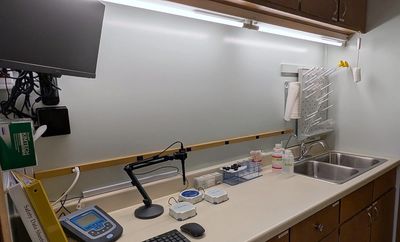
The District operates its own water analysis laboratory at our office in Stafford. It offers quick, low-cost screening of nitrate and chloride concentrations.
Nitrate analysis
Chloride analysis
Laboratory water quality: Reagents and standards are prepared with water purified by a Typhoon III reverse osmosis/deionization system, which helps keep contaminants out of the testing process.
How to read your nitrate result: Nitrate results are reported as nitrate-nitrogen (NO₃-N), the same unit used in the EPA drinking water standard of 10 mg/L.
Quality assurance: To check the accuracy of our results, the District periodically sends samples to a KDHE-certified laboratory and compares those results with our own. These comparisons have shown good agreement with the certified lab.
Please note: The District’s laboratory is not certified by the Kansas Department of Health and Environment (KDHE). Results are intended for screening and general assessment. For regulatory, legal, or real estate purposes, or to test for other contaminants such as bacteria, arsenic, or uranium, please use a KDHE-certified laboratory.
Nitrate can enter groundwater from fertilizer, livestock waste, and septic systems. The EPA drinking water standard is 10 mg/L (as nitrate-nitrogen). Water above that level can be harmful, particularly to infants under six months and pregnant women.
Chloride is a naturally occurring salt, and elevated levels can signal mineral intrusion into the freshwater aquifer. High chloride can affect taste, damage plumbing and equipment, and harm crops. The EPA’s secondary (taste) guideline is 250 mg/L.
The District monitors groundwater through a network of observation wells. In total, there are nearly 250 water level measurement sites, and nearly 150 of them are water quality sites. Sampling these wells over time lets the District spot trends and respond to areas of concern.
The District is in the process of adding additional monitoring sites throughout the western half of the District. If you would be interested, please contact the office to discuss details.
The Kansas Geological Survey (KGS) is developing a comprehensive groundwater quality monitoring network. The program aims to:
Water users can contact KGS to take part. Learn more about the program.
Copyright © 2026
Big Bend Groundwater Management District 5 - All Rights Reserved
This website uses cookies. By continuing to use this site, you accept our use of cookies.
